If you grew up playing Sim City, you probably remember the weird satisfaction of balancing tax rates, road layouts, and power lines just to keep a tiny pixel city alive. Like Age of Empires, it turned out to be secretly educational: hidden inside the fun were real ideas about planning, economics, geography, and even history.
For me, those games didn’t just pass the time—they quietly trained the part of my brain that likes systems: feedback loops, trade‑offs, and "what happens if I change this one thing?" That same curiosity now sits at the heart of the science simulations I’m building for Vibeteaching.io.
From cities to cells:
Instead of zoning districts and laying pipes, we’re now tweaking enzyme activity, orbital electrons, and biomedical test panels—but the design mindset is exactly the same.
Why simulations still matter
Modern learners are surrounded by fast content—but deep understanding still comes from playing inside a system. Good simulations give you a safe sandbox to try ideas, break things, and see the consequences in real time. That’s the spirit behind the growing collection of science sims on Vibe Apps.
Over the last few months I’ve been building and releasing several new simulations that echo the spirit of games like Sim City—rich, consequence‑driven worlds, but mapped onto real science curricula.
Launching the Biomedical Techniques Virtual Lab
One of the biggest new releases is the F173 Biomedical Techniques Virtual Lab—a browser‑based lab where you act as a trainee biomedical scientist in a hospital setting.
Instead of controlling traffic flow or zoning residential areas, you’re choosing which biomedical tests to run on three virtual patients, interpreting results, and deciding what to do next. It’s designed to map onto the F173 assessment criteria while still feeling like a game.
Key ideas you can practise:
- Planning investigations and choosing appropriate techniques.
- Understanding reference ranges, uncertainty, and test limitations.
- Reviewing data quality, spotting anomalies, and suggesting follow‑up tests.
- Reflecting on risk, ethics, and practical constraints in a real‑world lab.
Just like tweaking city budgets in Sim City, small choices domino into big outcomes. Pick an unnecessary test and you waste time and resources; miss a key panel and you risk an incorrect conclusion. The goal is to give students a low‑stakes environment to make those decisions before they ever step into a real lab.
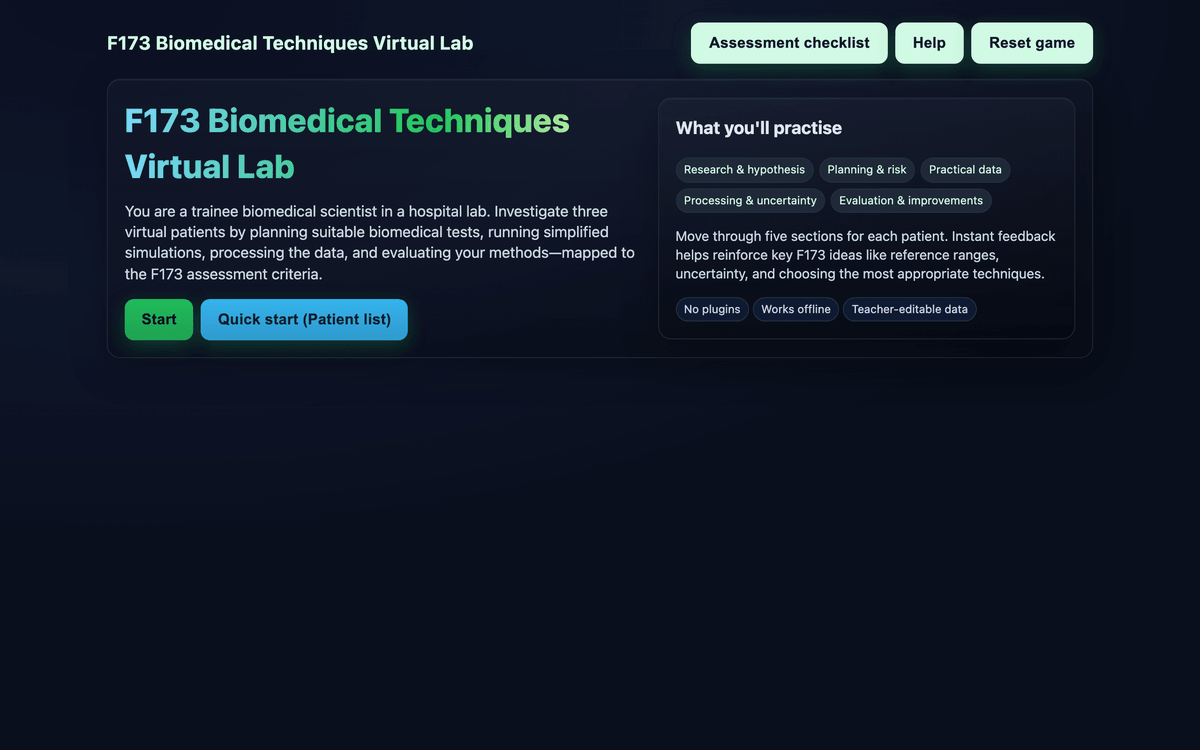
You can explore the live app here: Biomedical Techniques Virtual Lab.
Ionic Bonding Lab – electrons as city residents
Another recent project is the Ionic Bonding Lab. If the biomedical lab is a bustling downtown district, this one zooms all the way down to the level of electrons.
Students can explore how electrons move between metals and non‑metals, watch ions form, and then classify the resulting ions. It’s designed to make concepts like valence electrons, charge, and ionic compounds feel as tangible as placing buildings on a grid.
The app guides learners through steps such as:
- Choosing a metal and non‑metal pair (e.g. sodium and chlorine).
- Transferring the valence electron from metal to non‑metal.
- Observing the new charges and electron configurations.
- Sorting the resulting ions into positive (cations) and negative (anions).
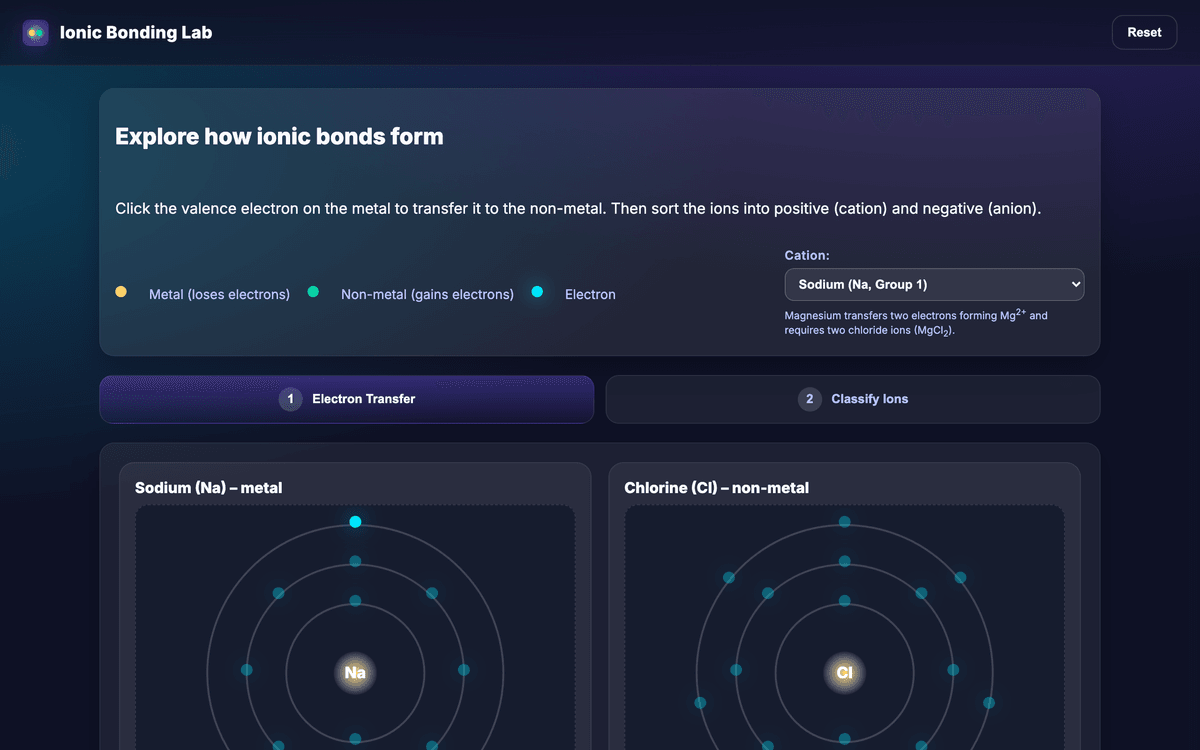
The live version is here: Ionic Bonding Lab.
Building sims the "vibecode" way
Behind the scenes, both apps are built in the same spirit as the rest of Vibeteaching: teacher‑editable data, transparent logic, and remix‑friendly code. If you’re comfortable with GitHub, you can dive into the source:
- Biomedical Techniques Virtual Lab GitHub: taggatron/biomedicaldiagnosis
- Ionic Bonding Lab GitHub: taggatron/ionicbonding
The aim is that over time, educators will not just use these tools but also fork, tweak, and extend them—turning a single city‑builder of an idea into a whole shared map of science simulations.
From player to builder
Sim City and Age of Empires quietly taught a generation of players how systems, trade‑offs, and strategies work. With Vibe Apps, I want to do the same for science—and then go one step further by inviting teachers and students to help build the worlds as well.
If you’ve ever lost an evening to optimising a virtual city or perfecting an empire build order, you already have the mindset needed to create powerful learning tools. The next step is simply to bring that mindset into the classroom.

Category: Simulations, Science Education, Creativity