Two years ago, building interactive educational software with AI felt like having a brilliant but amnesiac intern sitting on the other side of a chat window. You would prompt, copy a snippet, paste it into your editor, run the browser, watch it break, copy the error message back into the chat, explain what went wrong, and pray the model didn't rewrite half your variable names in the process.
Today, that paradigm is entirely obsolete. We have crossed into the era of Agentic Systems—where tools like Google Antigravity, ChatGPT Codex, and Google AI Studio don't just generate lines of code; they plan, inspect workspaces, execute tools, verify browser rendering, self-heal runtime errors, and autonomously construct complex software suites.
The Paradigm Shift:
We have transitioned from being prompt engineers micromanaging single functions to being pedagogical architects and creative directors orchestrating autonomous agentic workflows.
To celebrate this leap, we have just published the brand-new Virtual Science Laboratory to our Vibe Apps Directory, while officially retiring our legacy Impact Explorer. Here is the story of how agentic systems made this new generation of interactive science simulations possible.
Two Years Ago: The Friction of Early AI-Assisted Coding
Around two years ago, I built the Impact Explorer (GPE Impact Crater Simulation). The vision was straightforward: allow GCSE and Secondary physics students to drop asteroids of varying masses and velocities onto planetary surfaces, calculating Gravitational Potential Energy ($E_p = mgh$) and kinetic energy to simulate crater diameter and depth.
While the final simulation was a great classroom demonstration, the process of building it using early AI-assisted coding was filled with friction:
- The Human Compiler Trap: The AI model had no direct access to the filesystem, terminal, or browser. Every single code change had to be manually transferred, verified, and debugged by hand.
- Severe Context Degradation: After 4 or 5 prompt turns, the chat context would fill up. The model would forget previously established state variables, rewrite working canvas math, or introduce regressions.
- Brittle Physics & Canvas Sync: Getting the 2D HTML5 canvas animation loops, collision detection, and responsive graph axes to sync required dozens of iterative prompt turns just to iron out coordinate offset bugs.
- High Cognitive Exhaustion: As a teacher, 80% of my energy went into prompt wrangling and syntax debugging rather than pedagogical design and simulation depth.
It was clear that while AI assistance was revolutionary, single-turn chat interfaces placed a hard ceiling on the scope and fidelity of what an individual educator could realistically create.
The Agentic Revolution: Antigravity, Codex & AI Studio
Fast forward to today: Agentic Systems operate on a fundamentally higher order of intelligence and autonomy. Instead of waiting passively for the user to prompt each line, agentic environments execute goal-oriented workflows with deep tool access:
1. Google Antigravity: Multi-Tool Autonomous Orchestration
Google Antigravity represents a massive leap forward for end-to-end software creation. Rather than simply suggesting code, Antigravity functions as an autonomous pair programmer with full workspace awareness. It can:
- Analyze full project trees, TypeScript definitions, and dependencies in real time.
- Plan multi-stage architectural implementations, validating requirements before touching code.
- Execute CLI commands, launch local dev servers, and run test suites in background tasks.
- Spawn browser subagents to inspect DOM trees, verify responsive layouts, capture visual screenshots, and validate real UI behavior.
- Self-diagnose lint and compiler errors, iteratively applying fixes until the app compiles and runs cleanly.
2. ChatGPT Codex & Advanced Reasoning Agents
With advanced reasoning models and canvas-integrated coding agents, ChatGPT Codex excels at rapid visual synthesis, dynamic state machine design, and high-level algorithmic logic. It can take complex mathematical models—such as transpiration kinetics, rate equations, and thermodynamic equilibrium—and structure them into modular React hooks and canvas renderers with minimal intervention.
3. Google AI Studio & Gemini: Massive Context & Multimodal Ingestion
Using Google AI Studio powered by Gemini 1.5 Pro and Gemini 2.0, educators can ingest hundreds of pages of science curriculum specifications (AQA, Edexcel, OCR), lab manuals, apparatus diagrams, and existing code repositories simultaneously. With a million-token context window, the agent never forgets a variable, never hallucinates curriculum standards, and can cross-reference multiple practical techniques in a single pass.
Showcasing the New: Virtual Science Laboratory
The culmination of this new agentic workflow is the Virtual Science Laboratory—now live in our Vibe Apps catalogue and playable at codexvirtualchemlab-ng72.vercel.app.
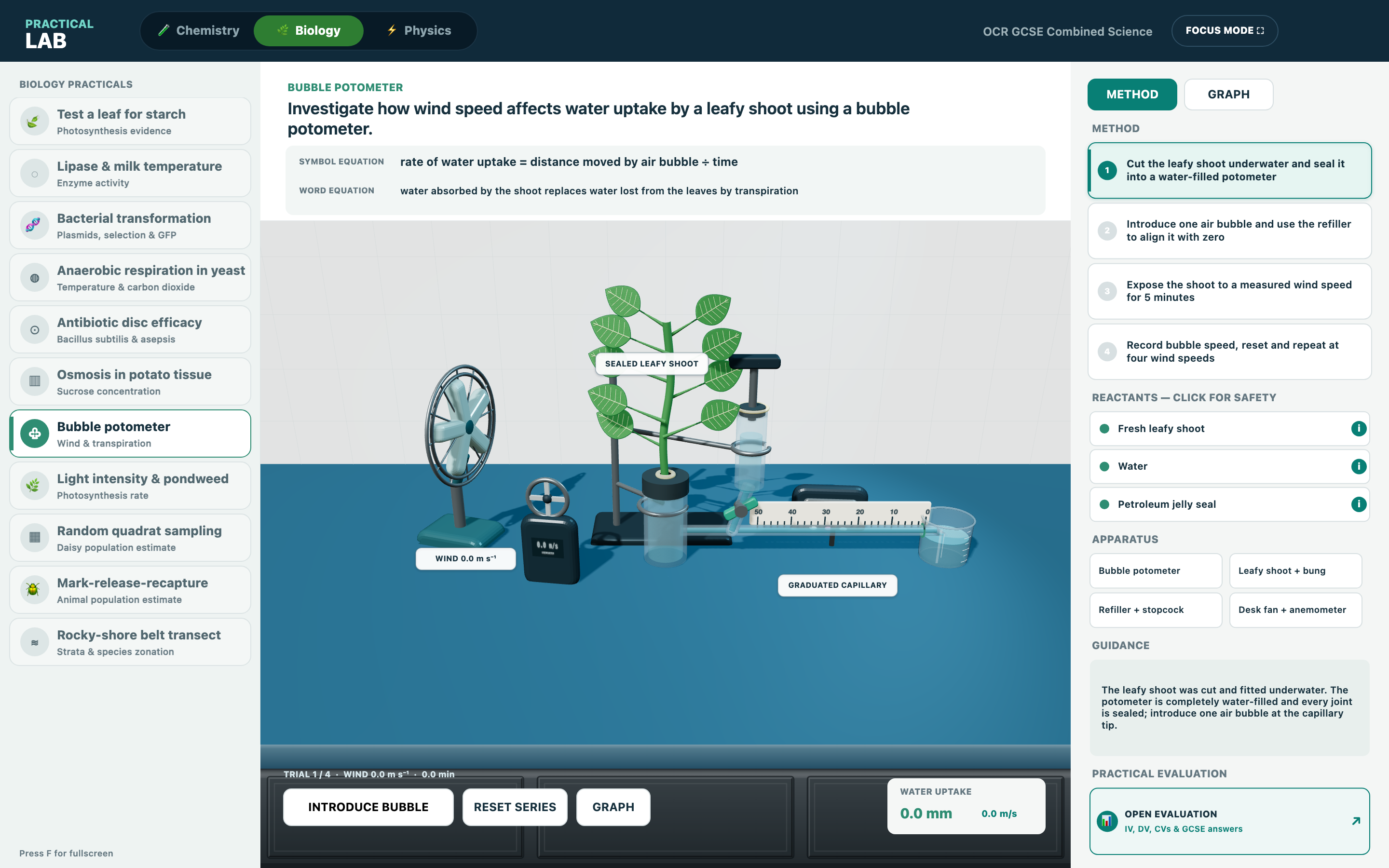
Unlike the isolated 2D canvas of the legacy Impact Explorer, the Virtual Science Laboratory is a full multi-practical interactive suite built with modern 3D apparatus, real-time physics and chemistry engines, live digital timers, automated data logging, and dynamic graph plotting.
Highlight: The Bubble Potometer Practical
One of the flagship experiments in the lab is the Bubble Potometer Practical, designed directly around GCSE and A-Level Biology curriculum requirements:
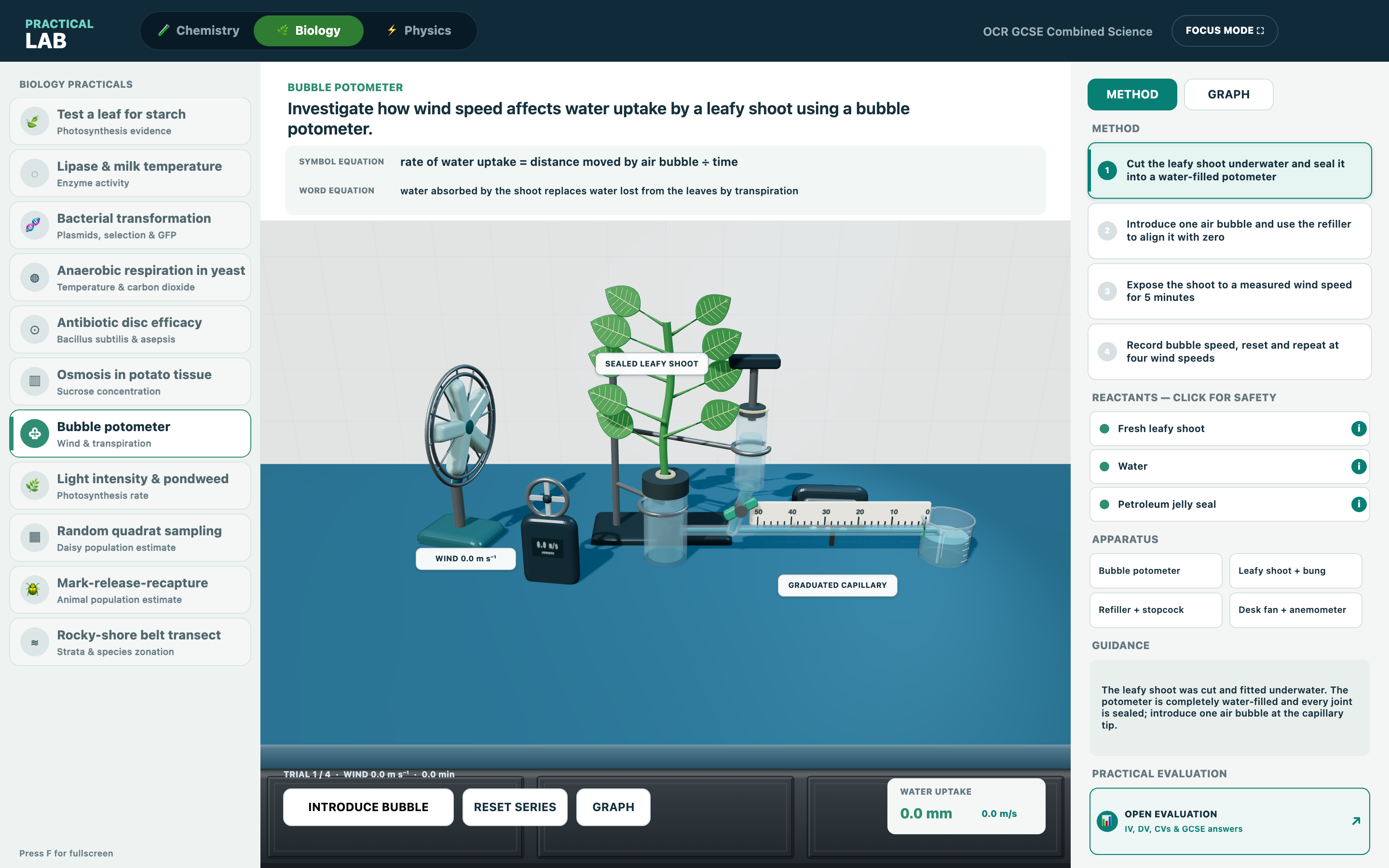
- Realistic Experimental Method: Students seal a leafy shoot into a water-filled capillary system, introduce an air bubble, and calibrate it to zero using the refiller reservoir.
- Environmental Parameter Controls: Adjust variables like desk fan wind speed, light intensity, and temperature to observe their direct impact on the rate of transpiration.
- Live Sensor Data & Graphing: As time ticks on the digital stopwatch, the simulation records distance traveled by the bubble ($mm/\text{min}$) and automatically plots rate-of-uptake curves with linear regressions.
- Multi-Subject Breadth: Seamlessly switch between Biology (potometer), Chemistry (rates of reaction with gas syringes, acid-base titrations), and Physics (electrolysis cell parameters).
Building this level of depth with manual prompting would have taken weeks of painful debugging. With an agentic system orchestrating the 3D assets, UI layout, math calculations, and state management, the entire simulation went from concept to live deployment in hours.
Side-by-Side: 2024 AI-Assisted vs 2026 Agentic Coding
Here is a direct look at how the development workflow has transformed:
| Capability / Workflow | AI-Assisted Coding (2024 - Impact Explorer) | Agentic Systems (2026 - Virtual Science Lab) |
|---|---|---|
| Interaction Model | Single-turn prompt & response in a chat box | Goal-driven autonomous execution across files & tools |
| Workspace Awareness | Isolated snippets; human pastes files manually | Full repository knowledge, AST awareness & dependency trees |
| Verification & Testing | Manual human browser testing & copy-paste errors | Autonomous browser subagents, DOM inspection & self-healing |
| Curriculum Ingestion | Few-line prompt summaries due to token limits | Massive context windows ingesting entire exam board specs |
| Simulation Scope | Single isolated 2D canvas experiments | Multi-practical 3D suites with live data loggers & graphing |
| Developer Role | Human compiler, syntax troubleshooter & tester | Creative director, prompt architect & pedagogical reviewer |
Retiring the Impact Explorer
As part of our commitment to maintaining a high standard of visual and pedagogical quality across VibeTeaching.io, we have officially retired the legacy Impact Explorer (GPE Impact Crater) app from our live catalogue.
The Impact Explorer was an invaluable milestone—it proved that browser-based, AI-crafted simulations could captivate students and illustrate physics formulas dynamically. But as agentic systems allow us to build richer, multi-faceted laboratories like the Virtual Science Lab, retiring older prototypes ensures our directory remains filled with state-of-the-art learning experiences.
The Future of Vibe Teaching
We are standing at the threshold of a new era in educational technology. When teachers are equipped with agentic tools like Google Antigravity, ChatGPT Codex, and Google AI Studio, the bottleneck is no longer coding proficiency or engineering bandwidth—it is simply pedagogical imagination.
If you can envision an interactive model that helps your students grasp an abstract concept, you now have the tools to bring that model into the world.
Check out the new Virtual Science Laboratory on our Vibe Apps directory, explore the practicals, and join us in building the next generation of interactive teaching tools!
Category: Agentic AI, Google Antigravity, ChatGPT Codex, Google AI Studio, Virtual Science Lab, Simulations, EdTech